




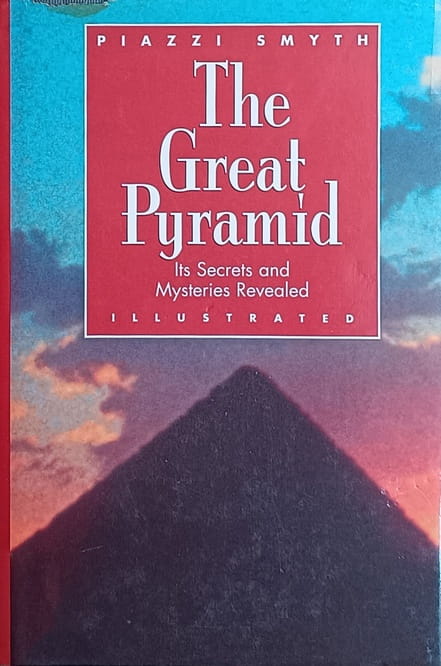
The Great Pyramid
16.00 €
Autor: Piazzi Smyth
Izdavač: Crown Publishers, New York
Godina izdanja: 1978.
Broj stranica: 664
Dimenzije: 16×23 cm
Uvez: tvrdi s ovitkom
Na zalihi
More than four thousand years ago, Egyptians built the Great Pyramid at Giza using mathematical and scientific laws that were not believed to have been discovered until two millennia later. These laws are so sophisticated and intricate that, to this day, no one has been able to fully explain how those early Egyptian masters could have learned their secrets.
The pyramids of Egypt in general and the Great Pyramid in particular continue to fascinate huge numbers of people from university professors researching the amazingly advanced mathematics of the ancient Egyptians to followers of the occult who feel they have acquired greater wisdom and personal power through study of the pyramids.
One of the great scholars in this area of Egyptology was Piazzi Smyth, whose major life work is contained in The Great Pyramid, which was originally published under the title Our Inheritance in the Great Pyramid in 1880. Smyth, the astronomer-royal for Scotland in the late nineteenth century, traveled to Egypt with his wife and spent many months camping out on the site at Giza so that he could thoroughly study the pyramid.
One of his beliefs was that in the Great Pyramid could be found measurements linking the structure to the teachings and events of Christianity. Smith’s precise calculations, metic ulous drawings, and logical reasoning produced truly astounding conclusions, which are found in The Great Pyramid. For example, if a circle is drawn around the base of the pyramid, the pyramid’s shadow hits a different point on the circle on each of the 365 successive days to make a calendar year, although at the time of the construction the Egyptians did not have anything resembling a 365-day calendar year. Another intriguing discovery is that the total weight of the stones used to create the pyramid is in the same proportion to its mass as that of the earth to its mass; of course, when the pyramid was built, the weight and mass of the earth were unknown.
The text of The Great Pyramid is augmented with all of Piazzi Smyth’s precise drawings and diagrams, as well as with more recent photographs of the interior of the pyramid and the exterior site at Giza, and a new Foreword written for this edition. In The Great Pyramid, Smyth’s superb research, painstaking calculations, and startling conclusions continue to weave the spell cast for millennia by the greatest of ancient structures.
Povezani proizvodi
POVIJEST I PUBLICISTIKA
23.89 €
POVIJEST I PUBLICISTIKA
6.64 €
POVIJEST I PUBLICISTIKA
26.50 €
POVIJEST I PUBLICISTIKA
26.50 €
Akcija!

AKCIJA
Izvorna cijena bila je: 5.31 €.4.25 €Trenutna cijena je: 4.25 €.

POVIJEST I PUBLICISTIKA
13.50 €

POVIJEST I PUBLICISTIKA
25.00 €
Akcija!

Izvorna cijena bila je: 13.28 €.10.62 €Trenutna cijena je: 10.62 €.